|
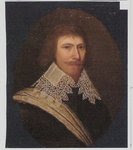
| Robert Stewart (1553-1593) |
Robert Stewart, Earl of Caithness and Orkney (1553-93), was a natural son of King James V
of Scotland by Euphemia Elphinstone (b. 1509), daughter of Alexander, 1st
Lord Elphinstone. He was half-brother to Mary, Queen of Scots (1542-1587), and
to James Stewart, Earl of Moray (1531-70), a prominent figure in Scotland’s Protestant
cause.
Young Robert was raised with three other illegitimate (but
acknowledged) sons of James V: James senior, son of Elizabeth Shaw; James secundus (the future earl of Moray), son of Margaret Erskine; and
John, son of Elizabeth Carmichael.
 |
| Ruins of Holyrood Abbey |
Then, in 1548, the three of them were
sent to France to be educated, probably under the tutelage of the famed French
humanist, Peter Ramus. He traveled to France with his half-sister, the princess
Mary, who was betrothed to Francis, the dauphin of France. Robert returned to
Scotland in 1557. (8)
Protestant Reformer, John Knox, returned to Scotland
from exile in the winter of 1555-56. By this time, Robert’s father had been
killed at the Battle of Flodden, and the power of the Crown rested in James’s
queen, Mary of Guise, an ardent Catholic and regent of Scotland during the
minority of her daughter, Mary, Queen of Scots. Through his half-brother James secundus (later 1st earl of
Moray), Robert was drawn to the Protestant faction. Present at parliament in
November 1557, he probably played no serious role in the undertakings of the
Lords of the Congregation, a group of Scottish Protestant noblemen, led by his
brother James, who were arrayed against the queen regent. Stewart was at times
present at gatherings of the Congregation, and though he did not play a major
role, was in attendance when the Lords entered Edinburgh in 1559 to oppose the Catholic Scots and their French allies. When the French made a show of force, however, a number
of the supporters of the Lords of the Congregation fled, and at this time
Robert was put in charge of the counter-attack, though he submitted to the
regent shortly after (9-10).
When
James Hamilton, 3rd earl of Arran, was tried for treason for his
role with the Congregation, Stewart, siding with the regent, gave testimony
against him, yet when the English invaded in March, Robert, perhaps seeing a
renewed rise in Protestant power, wavered again and bolted to their side,
signing the Treaty of Berwick between the English and the Lords of the
Congregation on May 10. Though Robert’s vacillation may have been more political
than religious in intent, he did renounce Catholicism at parliament in August. This
vacillation is what biographer Peter D. Anderson called signs of Stewart’s “undoubted
untrustworthiness” (10-11).
 |
| Mary, Queen of Scots |
James Stewart, a forceful and competent man, was made
1st Earl of Moray in January 1561-2, and Anderson avers that Robert
stood always somewhat in the shadow of James and their other brother John (42).
Even so, Robert remained prominent at
court and is known to have participated in festivities in November 1561 when he
agreed to join a “ride at the ring.” Robert, as it turned out, led the winning
team, who were all dressed as women, against Mary’s uncle of Guise, Rene
d’Elboeuf, who were dressed as “strangers in fancy dress” (Fraser 214).
Robert’s relationship with Mary was a warm one. He offered her the gift of a
horse, and she showered him with lavish garments of velvet, silk, and taffeta,
and other gifts from the treasury (Anderson 43). Though the queen showed trust
in Robert by employing him in various errands on her behalf, she never gave him
a title, though she did grant him lordships, lands, and the sheriffdom of
Aberdeen. More importantly, in December 1564, he was granted infeftment of the
lands of Orkney and Shetland (44, 47).
 |
| Henry Stewart, Lord Darnley |
When Mary made known her interest in marrying her
first cousin Henry Stuart, Lord Darnley, it was Robert who greeted the
nineteen-year-old dandy at Holyrood and hosted him for three days in February
1565. Despite their age difference (Robert was now 30), the two developed a
friendship, and, along with Darnley’s father, Lord Lennox, gained a reputation
for being the “greatest enemies of all virtue,” as English diplomat Thomas
Randolph put it, adding that Robert was “vain and nothing worth, a man full of all evil,
the whole guider and ruler of my Lord Darnly [sic]” (45).
On the same day that the wedding banns for Mary and
Lord Darnley were announced, May 10, 1565, Darnley, having been made Duke of
Albany, then knighted Robert Stewart. Being close to Darnley, however, did not
long prove to be an advantage, as the queen’s original happiness with Darnley
had soured by early 1566. In March, Lord Robert was seated with the queen and
her Italian secretary David Rizzio, when Darnley and his followers burst into
Mary’s chamber and murdered the man. Though present, Robert is deemed not to
have been involved in the plot. After this, his relationships with both Darnley
and Mary cooled, and he was not present at court for several months (47-49).
A year later, he may have been aware of Mary’s plot to
assassinate Darnley, however. Though Lord Robert was not complicit, George
Buchanan, writing in 1827, stated unequivocally that Robert knew of the
conspiracy and, “moved by the atrocity of the action, or by pity for the youth,”
warned the king of the queen’s plans for him. Darnley, “according to his
custom,” says Buchanan, immediately reported Robert’s communication to the
queen. When confronted, Robert “firmly denied it, when each giving the other
the lie, they drew their swords.” Though no violence occurred that night,
on the night of February 10, 1567, Darnley was assassinated (Buchanan 2:491).
 |
| James Hepburn, 4th Earl of Bothwell |
Events were moving quickly. First, the following May,
Mary took the lands of Orkney and Shetland away from Robert and gave them to her
lover James Hepburn, Earl of Bothwell, whom she elevated to the title Duke of
Orkney just days before their marriage. Taken captive by Scottish peers who
disapproved of the murder of Darnley and the marriage to Bothwell, Mary
abdicated on July 24, 1567. At that time, Robert Stewart was inactive for about
three months; then, on November 4, he suddenly appeared in Kirkwall, capital of
Orkney, assumed the role of sheriff, and announced himself to be “feuar of the
lands and lordship of Orkney and Shetland” (51). This set off a feud between
Robert and Patrick Bellenden of Auchnoll, who had hitherto held the office of
sheriff there. The earl of Moray, who was acting as regent to the infant King
James VI, continued to trust in his brother, but, perhaps in response to
complaints by Bellenden, did not immediately recognize his claim to Orkney.
Lord Robert, however, continued to throw his weight
around and clashed with Adam Bothwell, Bishop of Orkney, forcing him to
exchange the temporalities of the see of Orkney for Stewart’s abbacy of
Holyrood House. The bishop described the arrangement, thus:
“Lord Robert violentlie intruded
himself on his whole living, with bloodshed, and hurt of his servants; and after
he had craved justice, his and his servants' lives were sought in the verie
eyes of justice in Edinburgh, and then was constrained, of meere necessitie, to
tak the abbacie of Halyrudhous, by advice of sundrie godlie men” (DNB 5:444).
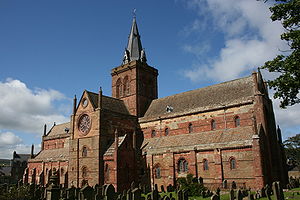 |
| St Magnus Cathedral, Kirkwall |
Stewart
quickly earned a reputation on Orkney for being a conniver who would stop at
nothing to get what he wanted. An example of this is provided in a violent
clash inside St. Magnus Cathedral in February 1568 when one Robert Brown, a
servant of Lord Robert’s, did not leave the cathedral grounds after prayer but
began to climb up on top of the cathedral’s arches. The bishop’s men shouted at
him to come down, and, offended, Brown re-entered the cathedral and complained
to Lord Robert’s men, who then went outside to quibble with the bishop’s men.
Seeing them approach, one of the bishop’s men shot Brown in the head, killing
him instantly. Robert’s men then returned to the cathedral and evened the
score, as they might have said, by killing two of the bishop’s men, one of whom
was kin to Patrick Bellenden. Lord Robert was not present at the time, and at
first maintained that he had no part in the assault and sincerely regretted
what his men had done in his name. However, some weeks later he admitted that
he had planned all along to take the church in an effort to prove to Bishop
Bothwell that he was in Orkney to stay. Perhaps in atonement for the killing
Bellenden’s kinsman, Stewart bestowed the bailiary of Kers on Bellenden, though
the peace between them was always tentative (Anderson 57-58).
For the next few
years, Robert endeavored to consolidate his authority in the Northern Islands,
mainly by confiscating lands and offices and handing them over into the keeping
of his family members and friends. As for the inhabitants of Orkney, he
undertook to arrange matters so that, to quote the old song, “They owed their
souls to the company store,” or to put it in medieval terms, he “was
establishing a quasi-feudal overlordship by taking the land on a
pretext—charges of witchcraft and suicide occur as well as of theft and
unauthorized departure from the islands—and then re-granting it to the same
persons or close relatives,” who would then be beholding to Robert for their
livelihood (73). Not long after his
arrival in the Isles, Lord Robert began building a palace at Birsay near the
old palace, long the residence of the bishops of Orkney, which he used as a
quarry for his stone. It appears to have been built in two stages. The first,
from 1569-75, saw the construction of a courtyard enclosed on three sides and
protected by a wall on the north side. The second phase, which may have been
undertaken by his son Patrick Stewart, saw the enclosure of the north side and
the removal of the wall (73-74).
 |
| Earl's Palace, Birsay |
In December 1575,
Lord Robert’s position in Orkney was severely threatened when he was charged on
four counts of oppression and usurpation of the king’s authority. The most
serious charge, treason, was based on his offering Orkney and Shetland to the
Danish king, a proposition he had no authority to make, though he was probably
banking on the fact that Orkney had only belonged to Scotland for a little over
a century. He was probably motivated by the desire to become the earl of Orkney
under the authority of the Danish king, who declined, noting that Stewart was “scurra et praestigiator iprobissimus, Scotus
natione, fuit,” in other words, a scoundrel and a cheat (87). As a result
of the trial, Stewart was imprisoned first at Edinburgh castle, then in
Linlithgow Prison near Edinburgh, for two years. When released in
1577, Robert did not return immediately to Orkney but remained in Edinburgh,
attending council meetings and “networking,” as we would put it today. In
particular, he used his time there to cultivate a friendship with the young
king, who was now eleven years old. He returned to Orkney in 1580 but continued
to build his friendship with King James in 1581 when he once again visited Edinburgh (106).
Stewart had gained a reputation as a self-aggrandizer, so it is possible his
friendship with an impressionable boy, who was, after all, his nephew, was
calculated to win him his long-desired earldom, which he did, in fact, receive,
along with the lordship of Shetland, on August 28, 1581. A year later, an
anonymous essayist, purporting to describe the “present state, faction,
religion and power of the nobility of Scotland,” sounded the familiar refrain:
the Earl of Orkney was “a man dissolute in lyfe; lyttle sure to any faction; of
small zeale in religion” (108). Apparently, his two years in the tank had not
made him reflective on the direction of his life.
 |
| James VI, age 20 |
He definitely
continued his oppression of the independent landowners on Orkney, and by 1586
the king, now twenty years old, was coming round to the consensus opinion of
Robert Stewart, for the French ambassador recorded that James “does not much
like the . . . Earl of Orkney, saying that he only serves his own ends” (111). No
doubt, James was to some extent stepping away from Earl Robert, who had placed
in his palace an inscription, in Latin, which, translated, read: “Robert
Stewart natural son of James V King of Scotland constructed this building,” one
possible implication being that Robert was calling himself the king! (114)
The Orcadians
continued to bring their complaints to the king, and the earl began to feel the
pinch in 1587, when parliament turned the lands of his earldom and lordship
over to his foes, Sir Lewis Bellenden of Auchnoull, justice clerk, and John
Maitland of Thirlestane, the chancellor (112), and it became increasingly possible
that Orkney would once again be held directly by the king.
In 1589, two
maneuvers of the earl suggested, if not reform, at least a sense of
self-preservation. First, he granted Sir Lewis Bellenden the lands of Evie,
which his old enemy Patrick Bellenden had once desired, and, second, he married
his daughter Elizabeth to James Sinclair of Murkle, who was the uncle of
William, Master of Caithness, who had been supporting Bellenden and Maitland
against the earl (117).
Of course, that he
carried out the duties required of all the earls really tells us little of the man’s
personal religious views (if any, for he seems to have been quite irreligious
all his life and was willing to turn whichever way the wind was blowing), and
upon his death on February 4, 1592, he was buried in the Stewart Aisle in St.
Magnus Cathedral, Kirkwall, according to the Roman Catholic ritual “with such
service as the rampant Calvinism of the day permit[ted].” (Hossack 51; Tudor 253)
Robert Stewart was married to Lady Janet Kennedy (1537-98), daughter of Gilbert Kennedy, 3rd Earl of Cassilis [pronounced "castles"]. They had ten children:
Mary (1553-1644)
Henry (1566-90)
Patrick, 2nd Earl of Orkney (1568-1614)
Jean (1570-1642)
John, Lord Kincleven, Earl of Carrick in Birsay (1576-1643)
James (b. 1577)
Robert (b. 1578)
Barbara (b. 1580)
Christian (1580-1644)
Elizabeth (d. 1642)
Works Cited
 |
| Spanish Galleon |
In the aftermath of
the Spanish Armada’s defeat by the English in 1588, Robert Stewart flirted a
bit with Spain, sometimes hosting Spaniards on Birsay. In July 1590, the earl “feasted”
Spaniards who had arrived in Orkney with three English ships they had taken off
Hartlepool in June. When they left, William Stewart, one of the earl’s
illegitimate sons, left with them, and participated in their attack on four
English fishing vessels off Fair Isle, one of the Shetland islands. These
vessels were taken to Kirkwall, where one of them was swapped with Earl Robert for
four cannon (124).
In 1589, the earl was
one of the commissioners appointed by the privy council of the kirk to execute
the acts against the Jesuits:
“Therefore the saids [sic] Lords of our Secreit Counsell at the humble and earnest desire of the Generall Assemblie of the kirk presentlie conveenned, have thought good, concluded, and ordeanned that our said commissioun and acts foresaid sall be putt in due and full executioun, by the persons respective after following, givin in by them in roll within the liberteis, shirefdoms, stewartreis, and bailliffereis, particularlie undermentiouned. They are to say the proveists and bailliffes of everie citie and burgh, justicers and commissioners within the self and liberteis of the same. And for the countrie to landwart, Robert Erle of Orkney, within the bounds of our shirefdome of Orkney” (Calderwood 42).
 |
| Interior, St. Magnus Cathedrdal |
Robert Stewart was married to Lady Janet Kennedy (1537-98), daughter of Gilbert Kennedy, 3rd Earl of Cassilis [pronounced "castles"]. They had ten children:
Mary (1553-1644)
Henry (1566-90)
Patrick, 2nd Earl of Orkney (1568-1614)
Jean (1570-1642)
John, Lord Kincleven, Earl of Carrick in Birsay (1576-1643)
James (b. 1577)
Robert (b. 1578)
Barbara (b. 1580)
Christian (1580-1644)
Elizabeth (d. 1642)
Works Cited
Anderson, Peter D. Robert Stewart: Earl of Orkney, Lord of
Shetland, 1533-1593. Edinburgh, John Donald, 1982.
Buchanan, George. The History of Scotland. Vol. 2.
Glasgow: 1827.
Fraser, Antonia. Mary Queen of Scots. New York: Dell, 1969.
Hossack, Buckham Hugh. Kirkwall in the Orkneys. Kirkwall,
William Peace, 1900.
Leslie, Stephen. Dictionary of National Biography. Vol.
5. London: 1886.
© Eileen Cunningham, 2017